
The tricks Pallas Capital learned from Jon Adgemis
The doctors and dentists of Bondi Junction may want to read the fine print.

Last month, I lifted the hood on Australia's private credit pirates, Metrics Equity Partners, and its co-morbid major shareholder, Pinnacle Investment Management.
I should say at the outset that my objective here is not to foment a gross generalisation that private credit is a dodgy asset class. For discerning investors, it can be a terrific one.
 Joe Aston
 Andrew McKean
But two things can be true at the same time: private credit is a legitimate investment product, and one where danger lingers in Australia's very poor standards of disclosure. This opacity serves as a honey pot for unscrupulous operators, of which there are many.
After the Australian Securities and Investments Commission deployed Richard Timbs and Nigel Williams to lift the lid on private credit's self-indulgences, ASIC responded by setting out its expectations for the sector in a November 2025 surveillance report. It complained that, "Many funds did not fully inform investors of related-party transactions or arrangements, including instances where the fund invested in loans made to a related party of the investment manager…"

A standout purveyor of this practice is Pallas Capital, the preferred real estate credit manager of Sydney's eastern suburbs set.
Headquartered in its own prime Double Bay development which counts Neil Perry's Margaret as anchor tenant, Pallas even employs enterprising socialite Ellie Aitken on its distribution team.[[The distribution team is merely a fund's sales/client relations function, so I'm not for a moment suggesting Ellie is responsible for any of the investment decisions or disclosure standards I deal with in this article.]] You get the picture.
In the June 2025 quarterly performance update of the Pallas Short Term Fund, for instance, the sole reference to related-party transactions was contained in the vague statement that, "Pallas capital continues to remain satisfied with the deployment of fund capital, and the performance of the underlying loans, which includes related-party lending exposures." Note the absence of any dollar figure, any percentage of the fund balance, or any breakdown by seniority of security.
This identical wording also appeared in the performance updates of Pallas High Yield Fund No.2, Pallas High Yield Fund No.3 and Pallas Warehouse Trust No.3.
I am focusing on these funds because, as they've recently been raising capital, I have been able to access their documentation. Together, they represent one-quarter of Pallas Capital's total funds under management. There is no doubt that Pallas has cleaner funds full of third-party loans that offer lower returns to institutional investors and via fund platforms for retail investors. The four I'm writing about are its spicier funds fed into the sleepy wholesale network, where most investors will barely scan the first two pages before remitting their $200,000.
The information memoranda of these four funds were barely any better than their performance updates, saying only that the funds are "permitted to make fund investments that involve related parties" of the manager; that the loans "must be made on an arms-length commercial basis"; and that the loans are "jointly and severally guaranteed by the related parties that hold a beneficial interest in the borrower". Those parties would be Charles Mellick, Patrick Keenan and Dan Gallen, the majority owners of Pallas Capital and of development company, Fortis, the related-party borrower.[[Fortis has publicly claimed it isn't a developer but a development consultant, because it doesn't itself own any properties. This is somewhat of a distinction without a difference, since the properties are usually substantially owned by the three Pallas/Fortis owners via special purpose vehicles and Fortis is the development manager of those SPVs.]]
Following ASIC's November 2025 report, the granularity of Pallas Capital's disclosures to its fund clients changed abruptly.
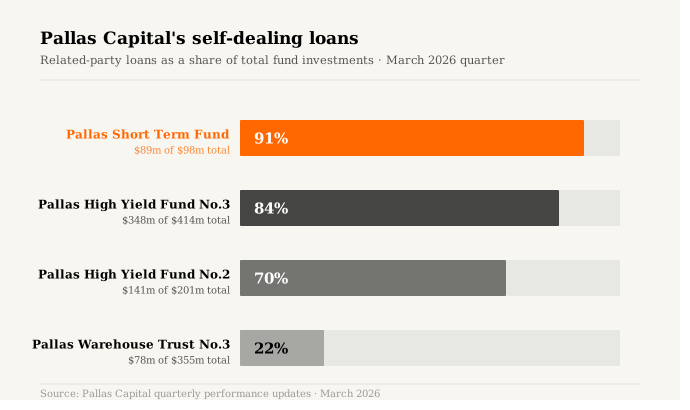
Pallas Short Term Fund's performance update for the March 2026 quarter dropped the stink bomb that of the fund's $98 million of total investments, $89 million – or 91 per cent! – were made to related parties.
Similarly, 70 per cent ($141 million) of the loans of Pallas High Yield Fund No.2 and 84 per cent ($348 million) of the loans of Pallas High Yield Fund No.3 were lent to related parties. For Pallas Warehouse Trust No.3, it was just 22 per cent ($78 million). All up, related-party loans represent a weighted average of 61 per cent of the total assets of the four funds ($656 million of $1.07 billion). We'll park these numbers and come back to them.
Did the average Pallas fund investor – virtually every doctor and dentist in Bondi Junction – previously comprehend that the vast majority of the loan book they were invested in was lent to Pallas' sister company Fortis? I doubt they comprehend it now![[How many private investors scour the fine print of quarterly performance reports for changes to disclosure templates?]]
Nobody quite knew the extent of this, and now to its credit, ASIC has shown everyone – should they care to look.
Any bog-standard mortgage fund tells prospective clients that when a loan goes bad, it will foreclose on the property, recoup the debt balance, and when there's a shortfall, chase guarantees from directors.
For Pallas clients, that just isn't a realistic scenario. Let's set aside the fact they're only now learning the true nature of the loan book. When the borrower of 60 per cent of the fund's money is, in effect, the manager itself, how can a unitholder be confident that Messrs Mellick, Keenan and Gallen will foreclose on their own development company let alone pursue themselves personally? How can you ever really manage that conflict?
Quite miraculously, there is not a single related-party loan in these four Pallas funds that is non-performing – and bear in mind, two of these funds are high yield funds, which contain the highest-risk loans. Having closely examined the ways Pallas tricks up its numbers on individual property deals, I can see just how its default rate can remain so squeaky clean.
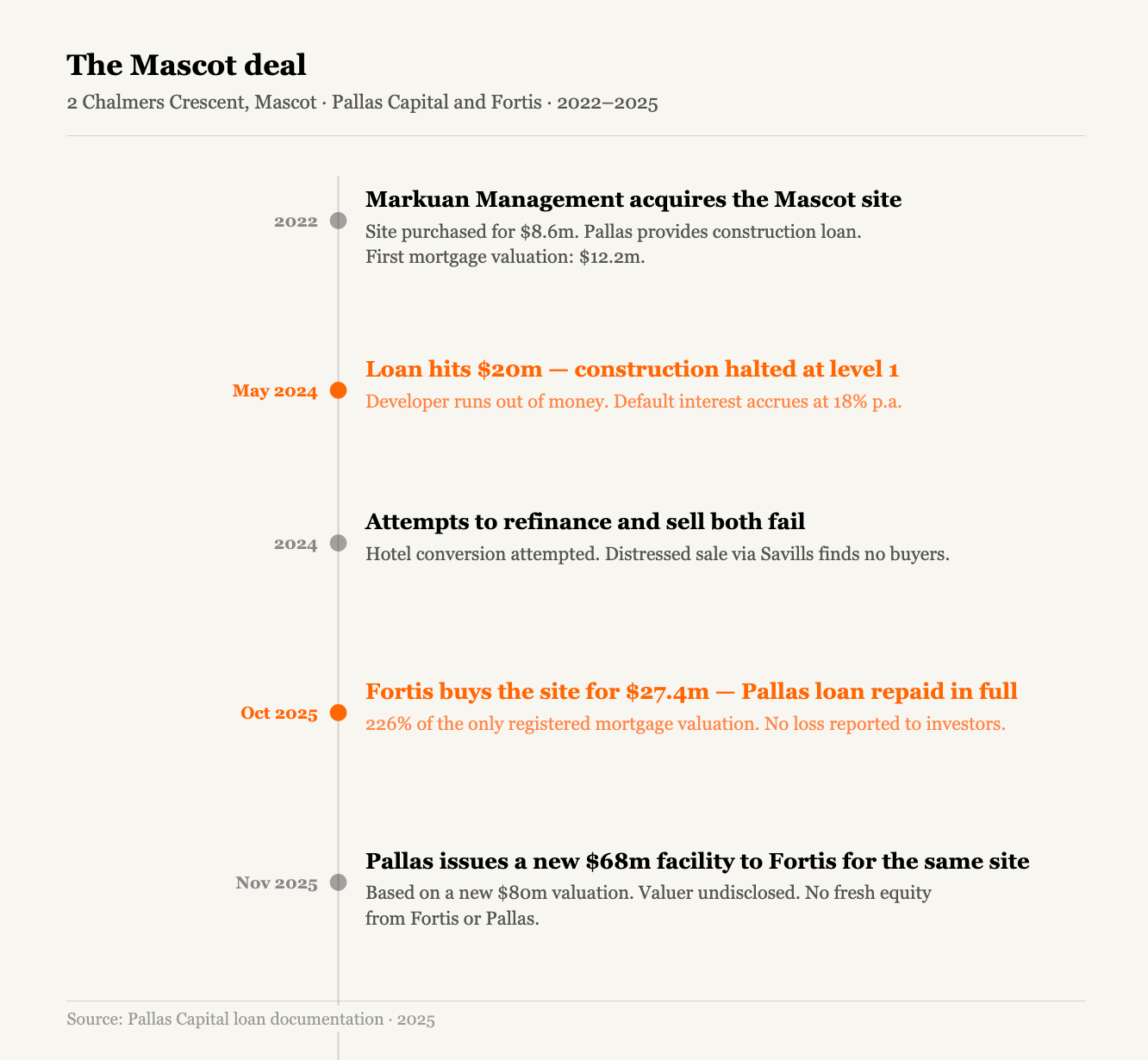
Take its project at 2 Chalmers Crescent, Mascot, a few doors down from Qantas headquarters near Sydney Airport. The site was acquired by a Chinese developer, Markuan Management, in 2022 for $8.6 million and Pallas provided the construction loan for a planned strata office block. A valuation for first mortgage security purposes of $12.2 million was provided in July 2022 by m3 Property.
By May 2024, with the loan balance at $20 million and default interest accruing at 18 per cent per annum, cost overruns meant the developer was out of money and construction was halted at level 1. Markuan tried to pivot the project to a hotel development, securing an "as if complete" valuation of $58 million from Ray White, which disclaimed, "This advice is not prepared for and nor is it suitable for mortgage purposes". An attempt to refinance, and then a distressed sale campaign through Savills, were both unsuccessful. Nobody would lend to the project or buy the site at a price that would clear the Pallas loan.
In October 2025, Fortis acquired the site via a special purpose vehicle for $27.4 million, and Pallas' loan was repaid in full.
Of course, you're not meant to buy a development based on what it owes your sibling credit fund. You're meant to buy it at its true value and let that credit fund write off its bad debt. Here we see the insurmountable conflict. This was a distressed opportunity – a development gone bad – and yet Fortis's purchase price of $27.4 million was 226 per cent of the only registered first mortgage valuation on the land! It is not an enormous leap of logic to suggest that Fortis overpaid to avoid Pallas having to realise a loss on its loan – a loss it would've had to report to fund clients.
Responding to Rampart's questions, Pallas Capital rejected the suggestion it overpaid for the site. "Several offers to acquire were received for this property [whose] price and terms were below but similar to the eventual sale price."
In November 2025, Pallas issued a new $68 million facility to Fortis for the Mascot project, based on a new $80 million valuation, thereby claiming a loan-to-value ratio of 85 per cent.[[The uplift was based on a DA-approved re-design of the internal floorplan, but there were no changes to the building's envelope or height and in fact hotel trading conditions had only become softer between mid-2024 and late 2025. Pallas says the higher valuation was legitimately supported by the increased number of rooms.]] Yet the identity of the valuer was not disclosed in the "executive summary" distributed to potential loan investors.
That document also touted an "approximately $98 million" value provided (presumably on a cocktail napkin) by a hotel sales agent. Neither $80 million nor $98 million was from a completed valuation for first mortgage security purposes, and even the $80 million valuation was $22 million higher than the last valuation – which also wasn't to be relied upon for first mortgage security purposes! Everyone knows you can ask a valuer to produce a market valuation and they'll write virtually whatever you want, since they're not putting their own indemnity insurance on the line.
The $68 million facility fully funds the cost of completing the hotel, so it's difficult to see how every dollar of investor capital has not been used to either clear the old loan or finish the building. Pallas explicitly rejects this, saying Fortis "made a substantial cash contribution to support the acquisition and is obliged to make a further contribution as the project progresses." Yet seemingly all of the sponsor "equity" is based on a (dubious) valuation uplift. Pallas also told Rampart it stood by the valuations on the project and is satisfied its loan is well secured.
Adopting "as if complete" valuations to secure loans greater than the genuine value of every site was, of course, the playbook of Jon Adgemis. Even the mention of that spiv's name will cause outraged spluttering from Pallas HQ, and to be clear, I'm not suggesting that what Pallas has done here is anything close to that irresponsible. But neither is it good practice.
 Joe Aston
To reinforce my point, let me walk you through one more Pallas deal. In October 2024, Fortis bought 377-383 New South Head Road, Double Bay at a receiver auction for $25.5 million – exactly the same price the previous owner paid in July 2021. There is no credible suggestion the property was purchased at anything but full market value.
Upon settlement four months later, Pallas provided Fortis with a $39 million first mortgage facility based on a $52 million valuation. How did they reach this incredible valuation that would enable them to borrow 150 per cent of the purchase price? They promised a $9.5 million upgrade to the building and signed a tenancy agreement with co-working company Forum Workspaces, which just so happens to share common ownership with Fortis and Pallas! The net rental rate Forum Workspaces will pay – $1,650 per square metre – is 3.5 times the net rent being paid by the outgoing tenant ($464 per square metre), also a co-working operator.[[The old rent was undoubtedly below-market, but reflects what is a non-premium building on a thunderous main road. This is not upstairs from Margaret – it is the arse end of Double Bay.]]
It turns out a light refurb and a related-party lease is all you need to literally double the value of a building in four months and borrow 100 per cent of your acquisition and development costs for a free punt with your clients' money.
This one actually is akin to an Adgemis job. For instance, he bought a block of Darlinghurst apartments in 2022 for $23 million but before he'd even paid that amount, his valuer Egan slapped a $58 million valuation on the building based on his Public Hospitality Group signing leases with itself to pay $2.7 million in annual rent (another tenant in the building, Optus, paid rent of $18,000 per year). Public immediately borrowed more than $32 million against the property.
I revealed this money-go-round in The Australian Financial Review in May 2023. The Pallas boys must've read my piece and said, Holy hell, that's genius; we should do that!
The inflated valuations relied upon by Fortis and Pallas are grossly unfair to Pallas' clients, who are inadvertently taking equity risk without receiving equity returns. If you were putting your money in an equity fund to develop that New South Head Road building, you'd want to be getting 18 or 20 per cent interest.
The first-ranking tranche in the New South Head Road mortgage is $26 million at a supposed 50 per cent LVR. A Pallas investor would look at that and think it's risk free and paying 9 per cent interest. Of course, it's not risk free at all.
The last $5.2 million subordinated tranche of the mortgage is paying 14 per cent interest at a supposed 75 per cent LVR, but in reality is pure equity.
Incredibly, of those $656 million of related-party loans in the four Pallas funds I introduced earlier in this piece, only $225 million (34 per cent) of those are registered first mortgages. Eighteen per cent ($117 million) are second mortgages and virtually half ($314 million) is preference equity, both sitting on top of first mortgages that – as you've seen – might be struck at 100 per cent of the true market value of the underlying security!
Are Pallas unitholders transacting here with their eyes wide open? That's debatable in the case of Double Bay, since the jacked-up valuation is based almost entirely on Pallas using itself as the tenant. Investors have bought into a mortgage fund but in practice are often providing development equity to three blokes with one-way pockets.
I can only tip my hat to aforementioned three blokes. It doesn't matter if their lovely-looking luxury apartments make much money because they rarely put much of their own money in to start with.
There is no visible pain yet, because they've never met the market. They are deft at kicking the can down the road. They tried selling their building next to Margaret (home to Baker Bleu and, upstairs, the equally appetising TDM Partners) but the offers were barely north of their development costs. The asset is therefore stranded in Pallas funds. Pallas will almost certainly have the same experience should they attempt to sell Mascot for $98 million or WeWork of New South Head Road for $52 million.
When (or if) they do eventually sell related-party developments below the holding valuations in their funds, fund investors will lose money but Pallas and Fortis will not. They might forego performance fees and suffer outflows, but they're certainly not going broke.
As I've been careful to say, Pallas is not comparable with Adgemis or his largely negligent lenders at the fundamental level. We are dealing here with a spectrum of sharp practice in private credit land and sadly, Pallas is not even that much of an outlier.
Even still, it would be advisable for Pallas to dial down the self-dealing and cease cutting corners. It's difficult to argue the conflicts of interest inherent in their business model are not leading to investment decisions that are contrary to the best interests of fund investors. If Pallas can get away with it, where is the incentive for other private credit managers to do the right thing, and to make less money doing it?


